The original item was published from December 12, 2024 12:31 PM to February 17, 2026 11:04 AM
December 12, 2024
Last month our team attended the annual Washington State Weed Conference in Wenatchee. Before your eyebrows raise off your forehead, let me assure you it was a group of professionals coming together to strategize and share notes on invasive plant management. Stephanie Helms and Maria Marlin of the Washington Invasive Species Council gave one of the most impactful talks reviewing the invasion curve. Have a look…
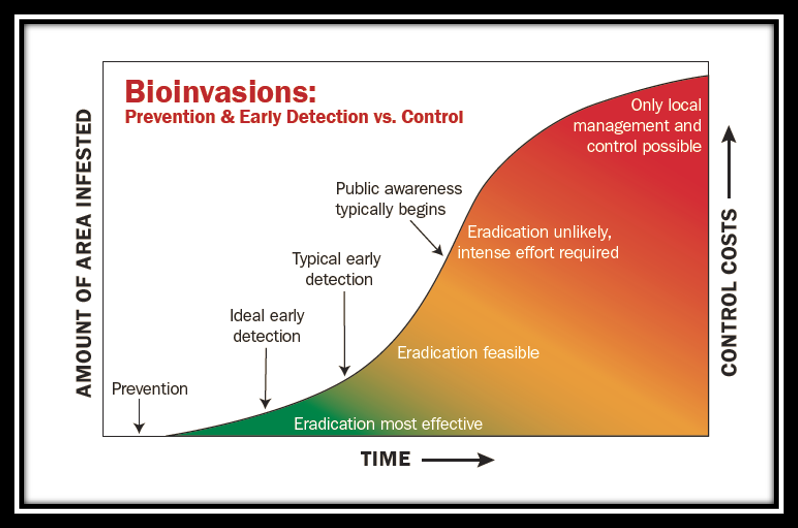
The chart is conceptual and doesn’t depict any one species; however, the idea that the population of a typical invasive species is slow to increase, and then explodes, is critical. Prevention and early detection (i.e. vegetation surveys, public education) are a major focus of invasive species programs because those management strategies offer the best opportunity to keep populations low, maybe even snuff them out altogether. Importantly this window coincides with lower control costs: money, but also time and effort. Regularly breezing through a problem site yanking out a few plants before they set seed, is much more rewarding than spending hours toiling away on large, neglected infestations.
Check out where public awareness comes in on the growth curve. Yikes! The chart suggests that by the time the public really starts to notice an invasive species, there’s a good chance we missed the boat. Think Himalayan blackberry or Canada thistle. They’re EVERWHERE…and so pokey!
If you read the last post, I wouldn’t blame you if you thought I was crazy for fussing over a few Scotch broom plants. The invasion curve is the reason for fussing. It shows that if we nip things in the bud, we have a chance at avoiding the laborious and disappointing consequences of exponential growth, some of which can include degraded habitat, degraded agricultural land, increased operational or management costs, loss of species, diminished recreation opportunities, and increased fire risk.
Next time your gaze falls on a potential or confirmed invasive plant, consider taking some time to observe and make a plan; or if you have a positive ID, take action! A little effort each day, or split between several members of a work party, can transform a “hopeless” patch into a manageable site with exciting possibilities for landscaping, gardening, or restored habitat. It takes a lot of these actions across our community to keep invasive plants in check on our special islands.
Got weeds and not sure where to start? Get in touch! Noxiousweeds@sanjuancountywa.gov or 360-376-3499